Social media content creation has changed dramatically over the last few years. Brands are no longer competing only on the quality of their products or services. They are competing on how quickly they can capture attention, tell stories, and create content that feels relevant to their audience.
For many marketing teams, this has created a new challenge. The demand for content continues to grow, but the traditional process of planning, creating, editing, and publishing content can be slow.
A single social media campaign may require multiple formats, including short videos, product clips, educational content, advertisements, and community posts. Managing all these assets manually can put pressure on small teams.
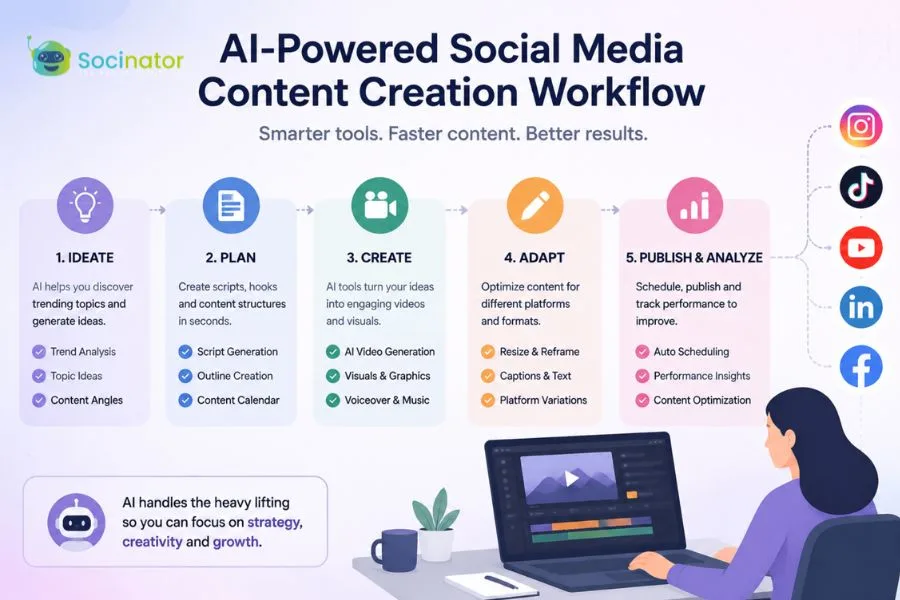
AI is changing this workflow by helping marketers move from isolated content tasks to more connected creation processes. Instead of using separate tools for every step, teams can now use AI to support everything from idea generation to content production and optimization.
The biggest shift is that AI is becoming less of a simple automation tool and more of a creative assistant that helps teams work faster.
The Traditional Social Media Workflow Challenge
Before publishing a social media post, teams usually go through several stages.
They need to identify content ideas, understand audience interests, create scripts or concepts, design visuals, produce videos, edit assets, and finally analyze performance.
Each stage often involves different tools and people.
For large organizations, this workflow can be managed through dedicated teams. However, smaller marketing teams often have limited resources and need to handle multiple responsibilities at once.
The result is a common challenge: brands have plenty of ideas but struggle to turn those ideas into consistent content.
AI is helping solve this by reducing the time required between planning and publishing.
From Content Ideas to Complete Concepts
One of the first areas where AI is changing social media workflows is content planning.
Marketers often spend significant time researching topics, brainstorming ideas, and deciding what type of content will perform well.
AI tools can help speed up this process by assisting with creative research, content structures, audience-focused ideas, and campaign concepts.
For example, a fitness brand planning a monthly social media campaign can use AI to explore different content angles, from educational videos to customer stories and product demonstrations.
This does not remove the need for strategy. Instead, it gives marketers more starting points to develop stronger ideas.
How AI Is Improving Video Creation Workflows
Video has become one of the most important formats across social platforms. However, video creation is also one of the most time-consuming parts of content marketing.
Creating a video usually involves scripting, visual planning, recording, editing, adding sound, and adapting content for different platforms.
AI is helping simplify this process by connecting different stages of video creation.
Instead of starting from an empty timeline, creators can use AI-assisted workflows to move from an idea or script toward a complete video concept.
Invideo Agent supports this type of connected workflow by helping creators develop videos from ideas, scripts, and references while keeping different stages of production connected. It can assist with planning, visual development, generation, editing, and refinement, making it useful for teams creating recurring social media content.
For brands running larger campaigns, invideo Agent Two helps coordinate more complex creative workflows by supporting areas such as visual planning, storytelling, and production decisions while keeping the overall direction consistent.
AI Helps Create Platform-Specific Content
Every social media platform has different expectations.
A video that works on TikTok may need a different pacing style for Instagram Reels. A LinkedIn audience may respond better to educational storytelling than to entertainment-focused content.
AI helps marketers adapt ideas into different formats instead of recreating every piece of content from the beginning.
For example, a product announcement can become:
- A short social video
- A customer-focused explanation
- A behind-the-scenes clip
- An advertisement variation
This makes content repurposing faster and allows brands to maximize the value of each campaign.
Personalization at Scale
Audiences increasingly expect content that feels relevant to them.
However, creating personalized content manually for different customer groups can be difficult.
AI is helping brands create more variations by adjusting messaging, formats, and creative approaches based on audience needs.
A software company, for example, may create different videos explaining the same product for startups, enterprise customers, and individual users.
Instead of producing completely separate campaigns, AI-assisted workflows allow teams to adapt existing ideas more efficiently.
AI and the Shift Toward Continuous Content Creation
Social media success often depends on consistency. Brands need to keep publishing, testing, and improving content based on audience response.
This has changed how marketers think about content creation.
Instead of planning only occasional campaigns, teams are building continuous content systems where ideas can be developed, produced, and adapted regularly.
AI supports this approach by helping reduce repetitive work and allowing teams to spend more time on creative decisions.
For example, a marketing team can use AI to create multiple versions of a campaign, analyze which direction performs better, and continue improving future content.
Maintaining Brand Consistency Across AI-Generated Content
As brands increase content production, maintaining consistency becomes more important.
A company may create dozens of videos across different platforms, but audiences should still recognize the same brand identity.
This includes:
- Visual style
- Messaging approach
- Product presentation
- Tone of communication
AI workflows can help teams maintain these creative guidelines across different content pieces.
This is especially useful for brands that create frequent campaigns and need multiple team members to contribute to content production.
Also Read
Creative and Tested Social Media Content Creation Strategies for 2024
The Role of AI Models in Social Media Content Creation
Different AI models are improving different parts of the content workflow.
Some models help generate realistic visuals; others support video creation, editing, or creative experimentation.
For example, AI video models help creators generate cinematic video sequences with improved scene understanding and motion quality. This can support brands in creating product videos, social campaigns, and storytelling content where visual quality matters.
Using different AI capabilities together allows marketers to choose the right approach depending on their content goals.
How AI Is Changing the Role of Social Media Teams
AI is not removing the need for marketers. Instead, it is changing how teams spend their time.
Previously, teams often spent a large amount of effort on production tasks. With AI assistance, they can focus more on strategy, audience understanding, creative direction, and campaign performance.
Social media professionals are moving from simply creating content to managing larger creative systems.
The ability to guide AI tools effectively is becoming an important skill for modern marketing teams.
What the Future of AI-Powered Social Media Workflows Looks Like
Social media content creation is moving toward more connected workflows where planning, production, and optimization work together.
Future AI systems will continue helping brands create content faster while maintaining quality and consistency.
The brands that benefit most will not simply be those producing the highest volume of content. They will be the ones using AI strategically to create meaningful content that connects with audiences.
Final Thoughts
AI is changing social media content creation by making workflows faster, more flexible, and easier to scale.
From generating ideas to creating videos and adapting campaigns across platforms, AI helps marketers reduce production challenges while focusing more on creative strategy.
The future of social media will not be about replacing human creativity. It will be about combining human insight with AI-powered workflows to create better content at a faster pace.