
Does your HRIS run payroll itself, or does it just pass the data to a separate system that cuts the checks? That single question sorts the market for anyone shopping for an HRIS with payroll. Plenty of tools call themselves all-in-one, then rely on a bolt-on payroll engine or a partner integration once you read the fine print. The distinction decides whether one employee record drives both your people data and your pay run, or whether you keep two systems in sync by hand.
This guide walks through ten platforms that pair a human resources information system with payroll, native or connected, and explains what each one does under the label. You’ll get a plain definition of an HRIS, a straight answer on whether an HRIS does payroll, and a read on where each option fits by company size and budget. Ratings and review counts come from G2, so the social proof is grounded in what buyers report, not marketing copy.
Quick answer before the breakdown
HiBob (Bob) is the best HRIS with payroll for a growing company, because it puts core HR and payroll on one employee record and carries a small team into the mid-market without a re-platform. It runs native payroll in the US and UK and connects local providers everywhere else through its Payroll Hub.
The five that lead the list
- HiBob (Bob): best HRIS with payroll for modern, people-first teams scaling from SMB into the mid-market.
- Rippling: best for companies that want HR, IT and payroll admin inside one workflow.
- Gusto: best for small US businesses that want payroll-first simplicity.
- BambooHR: best for small and growing teams that want a clean core HR record with payroll added on.
- Paychex: best for small businesses that want payroll plus hands-on HR services.
What an HRIS is and does HRIS do payroll
What an HRIS covers
A human resources information system is the system of record for your people data. It holds one profile per employee, covering their job and personal details, their pay and their time off. On top of that record sit the workflows HR runs every week, like onboarding a new hire or approving a leave request. Good systems add self-service so employees update their own details and managers approve requests without emailing HR. The better ones layer analytics on top, turning that clean record into headcount and pay reporting.
The line between an HRIS, an HRMS and an HCM comes down to scope. An HRIS centers on core records and administration. An HRMS adds more operational tooling such as time and attendance. An HCM stretches further into strategic talent work like performance, learning and compensation planning. Vendors use the three terms in overlapping ways, so read the feature list rather than the label.
Does an HRIS do payroll?
Yes, though how it does it varies, and that difference is the whole point of this comparison. Some systems run payroll themselves. They calculate gross to net, file federal and state taxes and pay employees from the same database that holds their HR records. That is native payroll. Because the pay run reads the same record as everything else, a raise or a new hire flows into payroll without a second entry. A bonus you approve in the HR screen shows up in the next pay run on its own, with no re-keying and no export to reconcile.
Other systems integrate payroll instead. The HRIS holds the people data, then passes it to a dedicated payroll provider through an API or a prebuilt connector. Integration works well when the connection stays tight and maintained, though it adds a second vendor and a sync step that can drift. The extra vendor also means two support lines to chase when a number looks wrong at month-end. When a listing says a tool offers payroll, check which model you are buying, and in which countries. A platform can be native at home and integrated abroad, which changes how much manual work lands on your team as you expand. Native keeps one dataset behind both HR and pay. Integrated keeps two systems talking, which is fine until they stop.
What to look for in an HRIS with payroll
Before you shortlist anything, get clear on a few things that decide fit more than any feature grid.
- Payroll model. Confirm whether the vendor runs payroll itself or routes it to a partner, and in which countries. A US-only native engine won’t help a team hiring in London.
- Company size and stage. Some tools cap out below a few hundred employees. Others carry real overhead that a 40-person team will never use.
- Compliance coverage. Tax filing, benefits administration and local statutory rules vary by country. Match the tool to where your people sit.
- Total cost. Look past the base fee to the per-employee price and the add-ons. Many vendors hide the real number behind a demo.
- Room to grow. The cost of switching systems later runs high, so pick something that still fits at three times your current headcount.
The 10 best HRIS with payroll platforms
HiBob (Bob)
Bob, the platform from HiBob, is modern HR software built for fast-growing, mid-sized and multinational companies, many of them distributed across borders. It starts from a core record called Bob Core, which unifies people data with self-service and configurable workflows, then lets you add suites for talent, planning and payroll as you need them. HR admins configure custom fields, permissions and joiner-mover-leaver flows without waiting on IT, and the analytics turn that clean record into live headcount and pay reporting. Those dashboards update as the record changes, so a headcount question gets a current answer instead of a stale export.
Payroll attaches two ways. Bob runs native payroll in the US and UK, filing taxes and paying staff from the same record that holds everything else. Everywhere else, its Payroll Hub connects the local provider you already use through no-code setup, so one dataset still drives both HR and pay. That native-plus-hub model is what makes Bob a genuine HRIS with payroll rather than a payroll tool wearing an HR badge. The platform leans hard on employee experience, with surveys and a mobile app people open without being told to.
The one honest knock: a few reviewers say the Talent area isn’t obvious in the navigation at first, and some would like faster support resolution. Pricing isn’t public; Bob quotes by module and headcount, and most teams go live in weeks.
What it is: An all-in-one HRIS and people platform with native US and UK payroll, plus global payroll through the Payroll Hub.
What G2 reviewers say: Bob holds a 4.5 rating from about 1,811 reviews on G2. Reviewers praise the clean interface and easy self-service for time off and performance, and they call out onboarding and org visibility as standouts. The recurring gripe is that the Talent section sits behind a menu new users miss, and some want quicker answers from support.
Rippling
Rippling started as a way to run HR and IT from one place, then grew into a broad workforce platform that also handles payroll, benefits and spend. Its pitch is unification: onboard an employee once and Rippling can provision their laptop, set up their apps and start their payroll from the same action. For a company that wants HR and IT admin under one roof, that reach is the draw.
Payroll is native in the US and extends to global payroll and contractor payments, which suits teams hiring across markets. The trade-off is weight. Rippling packs so many modules that new admins face a real learning curve, and the reporting draws the most complaints from people who expected it to feel simpler.
What it is: An HR and IT workforce platform with native US payroll and global payroll options.
What G2 reviewers say: Rippling carries a 4.8 rating across about 12,635 reviews on G2, one of the highest counts in the category. Reviewers love how easy day-to-day tasks feel once it’s set up, and clocking in and pulling payslips get the most mentions. The steady criticism is a steep learning curve from the sheer number of features, plus reporting that some find harder than it should be.
Gusto
 Gusto built its name on small-business payroll and has since added the surrounding HR pieces: onboarding, benefits and time tracking. For a small US company that wants payroll to feel painless, Gusto is often the first name people recommend, and the automated pay runs are the reason.
It stays US-focused, and the HR depth thins out as a company grows past a few hundred people. Customization is limited once your processes get specific, so Gusto fits the simpler end of the market better than a scaling mid-market team.
What it is: A payroll-first HRIS for small and medium US businesses, with native US payroll.
What G2 reviewers say: Gusto holds a 4.6 rating from more than 10,293 reviews on G2. Reviewers highlight how easy setup and payroll automation are, and how little time the pay run takes. The common complaints are customer support that can be slow to respond and occasional payroll or login hiccups, along with limited customization for teams with specific needs. Pricing starts around $49 a month plus about $6 per employee.
BambooHR
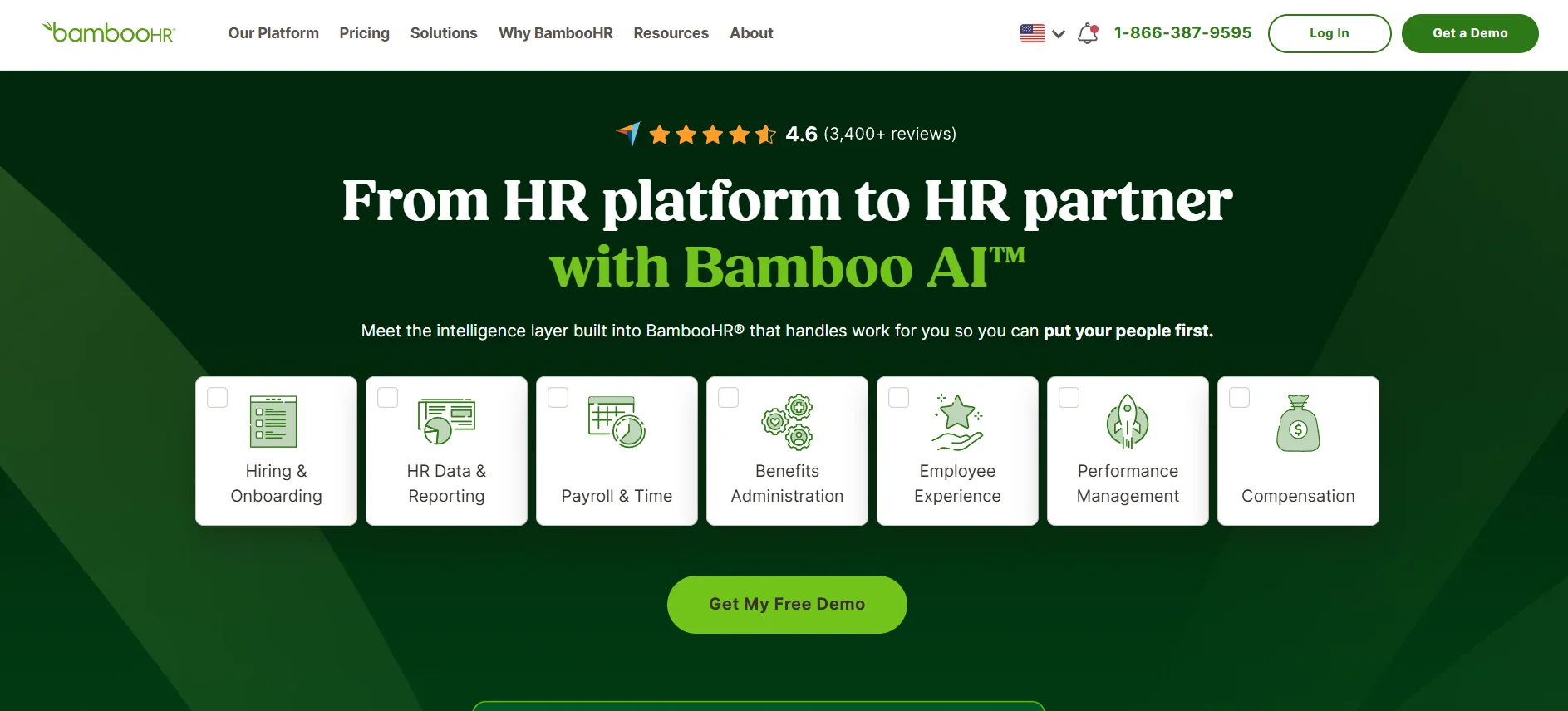
BambooHR is one of the most recognized names in SMB HR software, with a clean interface that HR teams and employees pick up fast. Its core covers employee records and onboarding, and it adds US payroll and benefits as paid modules on top of the base HRIS.
The catch shows up as companies get more complex. Customization and reporting hit limits that larger or process-heavy teams outgrow, and payroll being an add-on rather than part of the base means the all-in-one story only holds once you pay for the extra pieces. Where BambooHR Payroll isn’t in play, teams integrate a separate provider, which puts them back in the two-systems model. BambooHR publishes pricing from $10 per employee per month for Core, with payroll as a paid add-on.
What it is: A core HRIS for small and growing teams, with US payroll available as an add-on.
What G2 reviewers say: BambooHR earns a 4.4 rating across some 5,033 reviews on G2. Reviewers often name the clean, intuitive interface as the best part and praise how quick it is to learn. The recurring downside is limited customization and reporting depth, which reviewers say gets restrictive for larger or more complex workflows.
Paychex
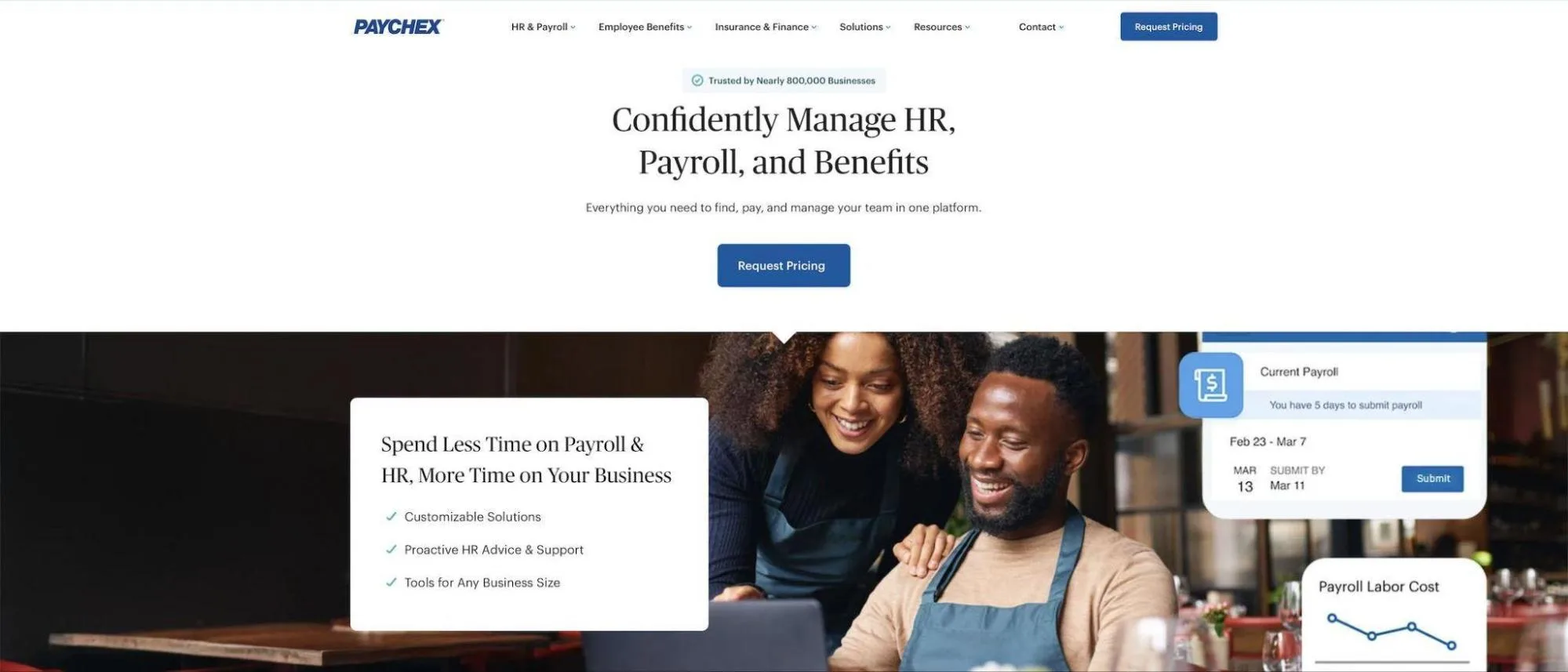
Paychex has run payroll for US small businesses for decades and pairs it with HR services, benefits administration and compliance support. Its strength is the services layer: a company that wants a provider to handle payroll taxes and HR paperwork, with people to call, gets that with Paychex.
The software can feel clunky in places (reviewers single out time and attendance), and pricing runs higher once you add services. Support quality draws mixed reviews, which matters most for a small team relying on Paychex to get pay right. On the payroll question, Paychex is native in the US, so pay data lives in the same place as the HR services wrapped around it.
What it is: A payroll and HR services provider for small and midsize US businesses.
What G2 reviewers say: Paychex sits at a 4.1 rating from about 1,739 reviews on G2, the lower end of this list. Reviewers value the payroll engine and the help of a dedicated service contact. The frequent complaints are inconsistent customer support, occasional payroll issues and cost that climbs as you add services.
ADP
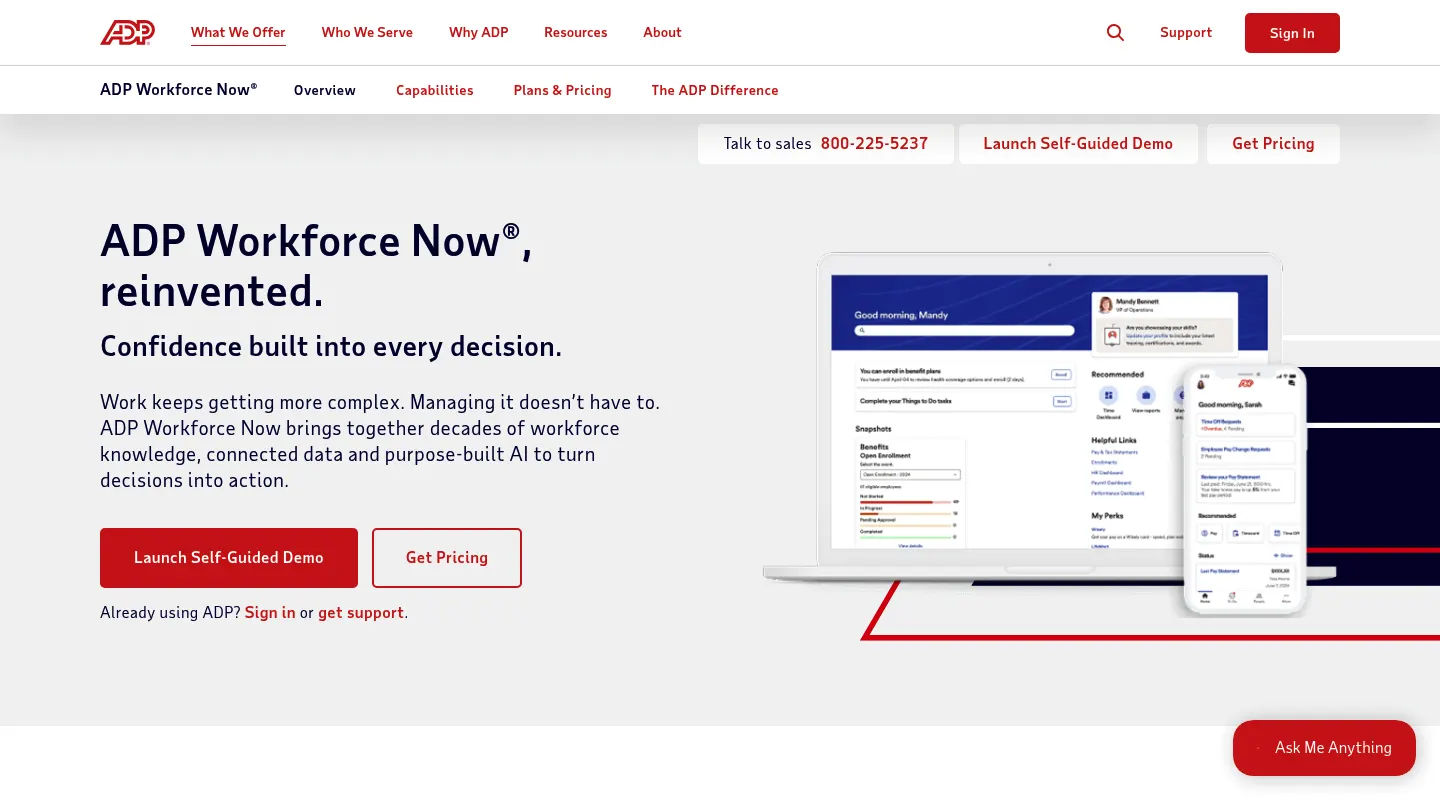
ADP is one of the oldest and largest payroll companies in the world, and its Workforce Now suite brings payroll and benefits, plus time and talent tools, to midsize and larger employers. For complex, multi-state or multi-country payroll with deep compliance and audit trails, ADP’s scale is hard to match.
That scale comes with friction. The interface asks for several clicks to do simple things, reviewers report features they expected to find missing, and customization of reports and workflows is limited for a platform of its size.
What it is: A payroll-led HCM suite for midsize and enterprise employers, with native payroll and tax filing.
What G2 reviewers say: ADP Workforce Now holds a 4.2 rating across about 4,209 reviews on G2. Reviewers value the centralized payroll and easy access to pay and benefits information. The common criticisms are clunky navigation that takes too many clicks, support that can disappoint and features reviewers expected but didn’t find.
Paycor
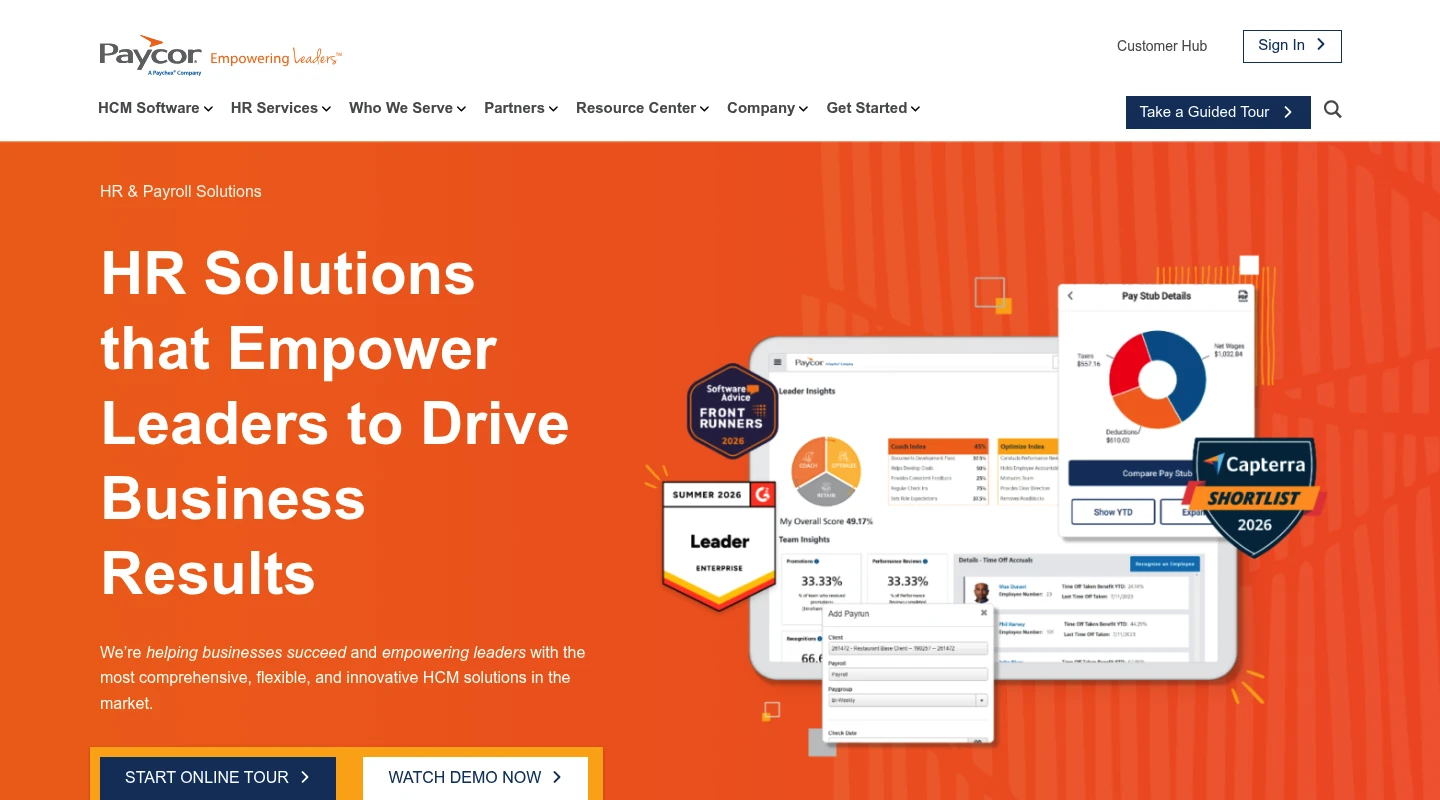
Paycor is a midmarket HCM out of the US that combines payroll with recruiting and onboarding, plus time and talent tools, aimed at HR teams that want one system for the employee lifecycle. It leans on payroll and time tracking as its core, and companies that live in those modules tend to like it.
Reviews turn cooler on support and reporting. Paycor draws the lowest G2 rating on this list, and the recurring themes point to service and reporting rather than the core payroll. It runs native US payroll, so the pay run and the HR record share one system, which is the part reviewers rate well.
What it is: A midmarket HR and payroll platform with native US payroll.
What G2 reviewers say: Paycor carries a 3.9 rating from about 1,333 reviews on G2. Reviewers find the payroll and time tracking easy to use and value quick access to their information. The steady complaints are poor customer support, missing features and reporting problems that get in the way of day-to-day work.
Paylocity
Paylocity is a US payroll and HR platform known for pairing the pay run with employee communication and engagement tools, which sets it apart from plainer payroll software. It fits midsize US companies that want payroll plus a bit of culture tooling in the same place.
New users report a climb before it clicks, and support and missing features come up often enough to note. The engagement features are a genuine plus, though they sit on top of a system that takes time to learn.
What it is: A midmarket US payroll and HR platform with native US payroll.
What G2 reviewers say: Paylocity holds a 4.4 rating across around 5,311 reviews on G2. Reviewers often praise helpful support agents and the intuitive design once they’re up to speed. The recurring downside is a steep learning curve for new users, with some pointing to missing features and inconsistent support.
Choosing the best HRIS with payroll for your team
The right HRIS with payroll depends less on the feature count and more on how payroll reaches your employees. If you want one record behind both HR and pay, favor a system that runs payroll itself in the countries you operate in, or one that connects your existing provider well enough that the two never fall out of sync. Payroll-first tools like Gusto and ADP win on the pay run but thin out on the people side. IT-first Rippling brings breadth at the cost of simplicity.
For a company scaling from a small team into the mid-market, HiBob strikes the balance the others miss: a modern people platform first, with native US and UK payroll and a Payroll Hub that keeps global pay on the same record. That is what a real HRIS with payroll should feel like in 2026, one dataset behind every decision your people team makes, right through to payday.