
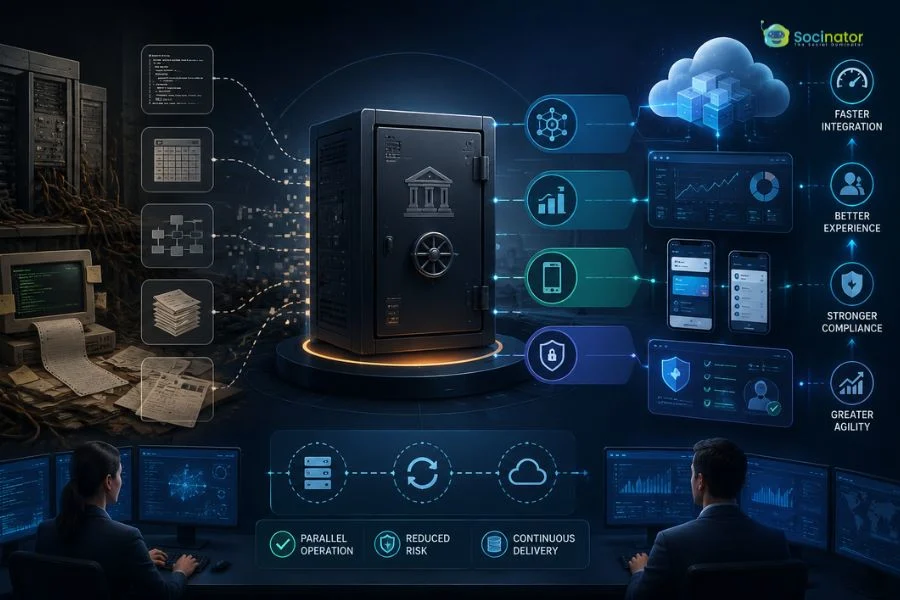
Most banks know their systems are old. What they disagree on is what to do about it. The usual advice is to rip out the core and start again, which is expensive, slow, and risky enough that plenty of programs stall before they finish. There is another route. Banking legacy modernization can happen in stages, around the core rather than through it, and it shows results far sooner.
Why do banks delay legacy modernization?
The main reason is fear of breaking something that currently works. A core banking system processes payments, holds balances, and feeds every downstream report. It cannot go offline for a weekend while someone tests a theory. TSB’s 2018 migration is the case everyone still points to: around five million customers affected, more than 230 days before the bank returned to normal operations, and roughly £400 million in total costs once fines and remediation were counted. Commonwealth Bank of Australia spent over a billion dollars and five years on its core replacement. Those numbers sit in the back of every board’s mind.
Then there is the money already going into upkeep. Accenture’s 2026 banking technology research puts legacy maintenance near 40% of IT spend at many institutions, and higher at some. When most of the budget keeps the lights on, little is left to fund a multi-year rebuild.
Compliance adds pressure from the other side. The EU’s Digital Operational Resilience Act came into force in January 2025 and requires banks to prove they manage ICT risk, test resilience, and control third-party dependencies. Old architecture makes that hard to demonstrate. Data sits in undocumented places, business rules live inside COBOL nobody wrote down, and the engineers who understood it are retiring.
Finally, the odds are not encouraging. IBM’s 2026 Global Outlook for Banking and Financial Markets found that 94% of modernization projects run past their original timelines. IBS Intelligence has reported that over half of banks name legacy core systems as their biggest obstacle to hitting business goals. Banks are stuck between a system that blocks progress and a replacement that might blow up the budget.
What can be modernized before replacing the core?
 Plenty of what frustrates customers and staff has nothing to do with the ledger itself. Banking legacy software modernization works well when you start with the layers that sit on top.
Integration layer:
This is usually the first and best target. Older cores talk through batch files, point-to-point connections, and middleware that has been patched for fifteen years. Putting a proper API layer in front of the core lets new services read and write without touching it. Once that layer exists, adding a payments partner or a KYC provider takes weeks instead of quarters. It also gives you a clean place to log, monitor, and control access, which helps with DORA evidence.
Reporting workflows:
Regulatory and management reporting often runs on overnight batches and spreadsheets held together by one person’s macros. Moving it onto a modern data layer separates reporting from core processing entirely. Reports get faster, reconciliation gets easier, and the audit trail improves, without changing how the core books a transaction.
Customer-facing services:
Mobile apps, onboarding, card controls, and servicing can all be rebuilt independently. ING’s staged approach through the late 2010s rebuilt the customer-facing stack first and left the core alone until later, cutting time to market for new products by around 60%. Customers judge a bank on the app, not the ledger behind it.
How staged banking modernization reduces risk?
Legacy system transformation in banking usually fails on scale, not on technology. Splitting the work into pieces changes the risk profile.
Lower disruption:
Each stage touches one part of the estate. If a release causes trouble, you roll back that piece and the rest of the bank keeps running. Nobody has to plan a weekend cutover for five million accounts. This is why the industry has shifted toward parallel and sidecar patterns, where a modern system runs alongside the old one and handles a small slice of customers or products first. IDC has projected that 40% of global banks will use sidecar strategies by 2026, rising to 70% to 80% by 2028.
Better release control:
Staged work forces you to build the delivery discipline you will need later anyway: automated testing, versioned APIs, deployment pipelines, and rollback that has actually been tested. Building that on small releases costs far less than discovering the gaps mid-migration.
More flexible architecture:
Every stage decouples something, and after a few rounds the core is no longer the only place logic can live. That matters commercially: you can change vendors, add a product, or launch in a new segment without a core project each time. Banking platform modernization done this way leaves you with options instead of one locked-in path.
How does Altamira support banking legacy modernization?
Altamira works with banks and financial services companies on exactly this kind of staged work. The starting point is an assessment of the existing estate: what runs where, what depends on the core, and which components carry the most operational and compliance risk. That produces a sequence rather than a wish list.
From there, Altamira’s engineering teams handle the pieces staged modernization depends on: API and integration layer development, data platform work to move reporting off the core, cloud migration for workloads that no longer need to sit on-premises, and rebuilding customer-facing applications. Teams can extend an in-house group or own a defined workstream outright.
Conclusion:
Replacing core banking software is rarely the first step in fixing an aging bank platform. The integration layer, reporting, and customer-facing services can all be modernized while the core stays where it is, and each stage pays for itself before the next one starts. If you want to know which part of your estate to tackle first, start with an assessment. Altamira can run one and hand you a sequenced plan you can take to your board.