
I asked AI Chat to help me design a social media system that could handle four platforms consistently without adding a single person to the team. The answer wasn’t a list of tools; it was a different way of thinking about where human time actually needs to go.
Most social media scaling problems aren’t staffing problems. They’re architecture problems. Teams attempt to grow output by doing more of the same things manually, hit a ceiling determined by available hours, and conclude they need more people. What they usually need is a better system.
Gary Vaynerchuk’s framing that “content is king, but context is God” points at exactly why scaling social is difficult. It’s not just about producing more; it’s about producing the right thing, for the right platform, with enough regularity that the audience stays engaged. Do that manually, and the operation becomes unsustainable. Build the right systems around it, and it becomes manageable for a team of two.
Why Social Media Teams Hit A Scaling Ceiling?
 The pattern is familiar. A brand decides to increase its social presence. The content calendar expands. Frequency goes up. Engagement expectations rise. The existing team absorbs the new volume. Somewhere around week six, consistency breaks down, posts go up late, response times slip, and content quality becomes uneven.
The problem isn’t effort. The effort is there. The problem is that every new platform, every additional post, every engagement thread requires time that doesn’t scale with the intention behind it.
The bottlenecks that appear most reliably are inconsistent publishing as team capacity fluctuates, slow engagement responses when volume exceeds bandwidth, fragmented workflows that treat each platform as a separate operation, and quality decline when production pressure increases.
When I described this situation to AI Chat, the first thing it identified was the difference between tasks that require judgment and tasks that simply require someone to press the right button at the right time. That distinction is the foundation of every effective social media scaling strategy.
Understanding What Automation Actually Does
 There’s a misunderstanding worth addressing directly: automation in social media is not about replacing creative or strategic work. It’s about removing the repetitive operational tasks that consume time without requiring judgment.
Scheduling a post to go live at a specific time requires no creative input. Generating a weekly engagement report requires no analysis. Distributing a piece of content across multiple platforms requires no strategic thinking. These tasks look like work because they take time. But they don’t require the capabilities that make a social media professional valuable.
When I used Chatly’s Ask AI app to audit a typical social media workflow, it flagged four categories of tasks that consistently absorb time without producing strategic value: manual publishing, platform-by-platform distribution, analytics compilation, and engagement queue management. Automating these four categories alone returns several hours per week to the people who should be spending that time on content quality and community relationships.
The tasks that automate cleanly include scheduled publishing across platforms, unified engagement monitoring dashboards, cross-platform content distribution, and automated performance reporting. Removing these from the manual task queue doesn’t reduce output quality. In most cases, it improves it, because team attention goes where it actually makes a difference.
Building an Efficient Social Media Workflow
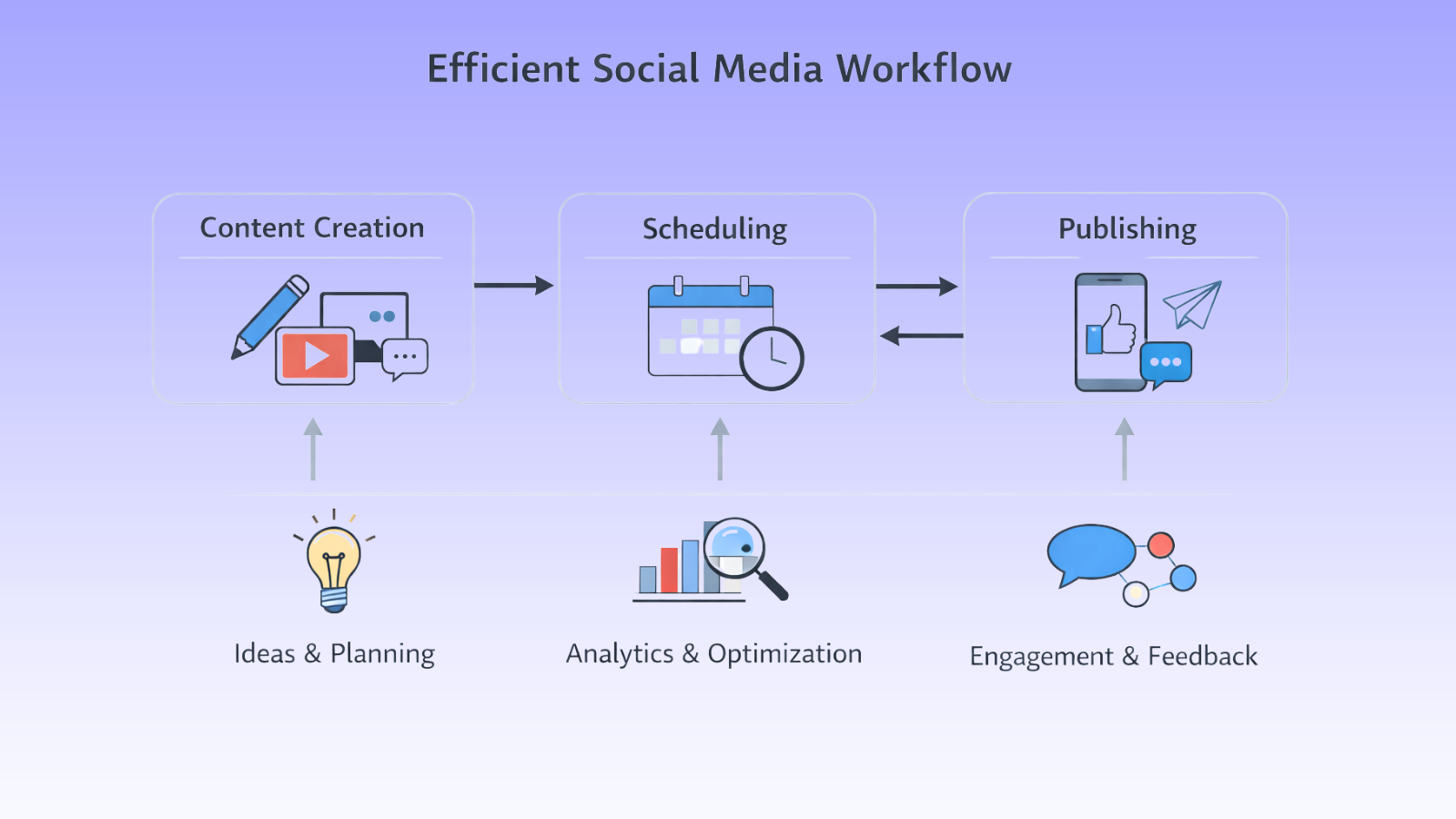 When working on social media campaigns, flow and momentum carry great weight, and for that, there has to be a systematic approach to it.
Content Batching
The single highest-leverage operational change most social media teams can make is shifting from daily content production to batched production.
Daily production creates constant low-grade pressure that fragments attention and makes strategic thinking difficult. Every day starts with a version of the same question: What are we posting today? That question, answered daily, consumes time and mental energy that compounds badly across a week.
Content batching restructures production into dedicated creation sessions, a week or more of content planned, produced, and scheduled in one sitting. Publishing consistency improves because the content exists before the deadline pressure appears. Thematic coherence improves because a full week can be planned as a set rather than as isolated posts. Quality improves because the team enters each session focused on creation rather than scrambling to meet a same-day deadline.
AI Chat is genuinely useful in the batching session itself. Use it to generate content angles for the week based on your core themes, suggest platform-specific adaptations of a central piece of content, or draft caption variations that can be tested across formats. What used to take a half-day of collaborative planning compresses considerably.
Multi-Platform Content Reuse
 Most content produced for one platform can be adapted for others with significantly less effort than creating from scratch. A detailed blog post contains enough material for a week of social snippets. A long-form video can be cut into shorter clips. An insight from a newsletter can be reformatted as a carousel.
This isn’t about cutting corners; it’s about recognizing that good thinking deserves wider distribution. The investment in developing a strong idea shouldn’t produce a single use.
When I asked an AI assistant to build a content repurposing framework for a weekly blog post, it mapped out eight distinct social content pieces that could be derived from a single article, each adapted to a specific platform’s format and audience expectations. That framework runs as a repeatable system now, not a one-off experiment.
Scheduling Systems
Automated scheduling removes the dependency between content being ready and content going live. A post scheduled for Tuesday morning publishes whether or not someone is at their desk.
Consistency is one of the most important signals an audience uses to evaluate whether to follow a brand. An account that publishes reliably earns the expectation of reliability. An account that publishes inconsistently, even if individual posts are strong, trains its audience to stop checking.
Scheduling tools convert intention into commitment. The content exists, the time is set, and distribution happens regardless of what else is competing for the team’s attention that day.
Where Automation Delivers The Greatest Efficiency?
 Content automation is the least that brands can do – but is it easy to execute? Let’s find out more.
Content Distribution
Manual multi-platform distribution means opening each platform, adapting the format, uploading content, writing the caption, configuring settings, and publishing, repeated for every platform, every post. Automation collapses this into a single workflow. Content prepared once gets distributed across networks simultaneously.
Engagement Monitoring
Monitoring comments, mentions, and messages across multiple platforms through native interfaces is operationally exhausting. Centralized dashboard tools aggregate all engagement signals into a single view, making it possible to monitor and respond across platforms without constantly switching contexts. The system handles finding what needs attention. The human handles what to do about it.
Performance Reporting
Manual analytics requires pulling data from multiple sources, formatting it consistently, and compiling something readable. Automated reporting handles this on a set schedule and delivers consistent output. Team time goes toward interpreting the data rather than assembling it.
Use AI Chat in the reporting layer too. Paste in your weekly metrics summary and ask it to identify patterns, flag anomalies, or suggest what the numbers might indicate about content strategy adjustments. It won’t replace the analyst’s judgment, but it accelerates the interpretation step considerably.
Risks of Over-Automation
 The efficiency gains from automation are real, and they come with a failure mode worth taking seriously.
Social media’s value, what distinguishes a brand with a genuine audience from one merely broadcasting content, is the quality of human connection it creates. Automated engagement responses that feel scripted erode that connection.
Content scheduled without attention to real-time context can produce tone-deaf moments during sensitive news cycles. Over-automation gradually strips personality from an account until it reads like a content feed rather than a brand voice.
The guardrail is under human oversight at the right points. Automation handles distribution, scheduling, monitoring, and reporting. It should never handle relationship-building interactions, creative decisions, or judgment calls about when standard content strategy needs to pause or adapt.
Brands that automate well look no different to their audience than brands operating manually, except more consistent. Brands that over-automate become visibly mechanical, and audiences notice faster than most marketers expect.
Conclusion
Scaling social media without expanding headcount is not a compromise. It’s a better strategy than manual scaling for most teams, more consistent, more sustainable, and more focused on the work that actually builds audience relationships.
The next time your team is feeling the strain of social media volume, before you write a job description, open AI Chat and describe your current workflow. Ask it where the manual dependencies are. Ask it what a batched, automated version of the same output would look like. The answer is usually simpler than expected, and significantly cheaper to implement.