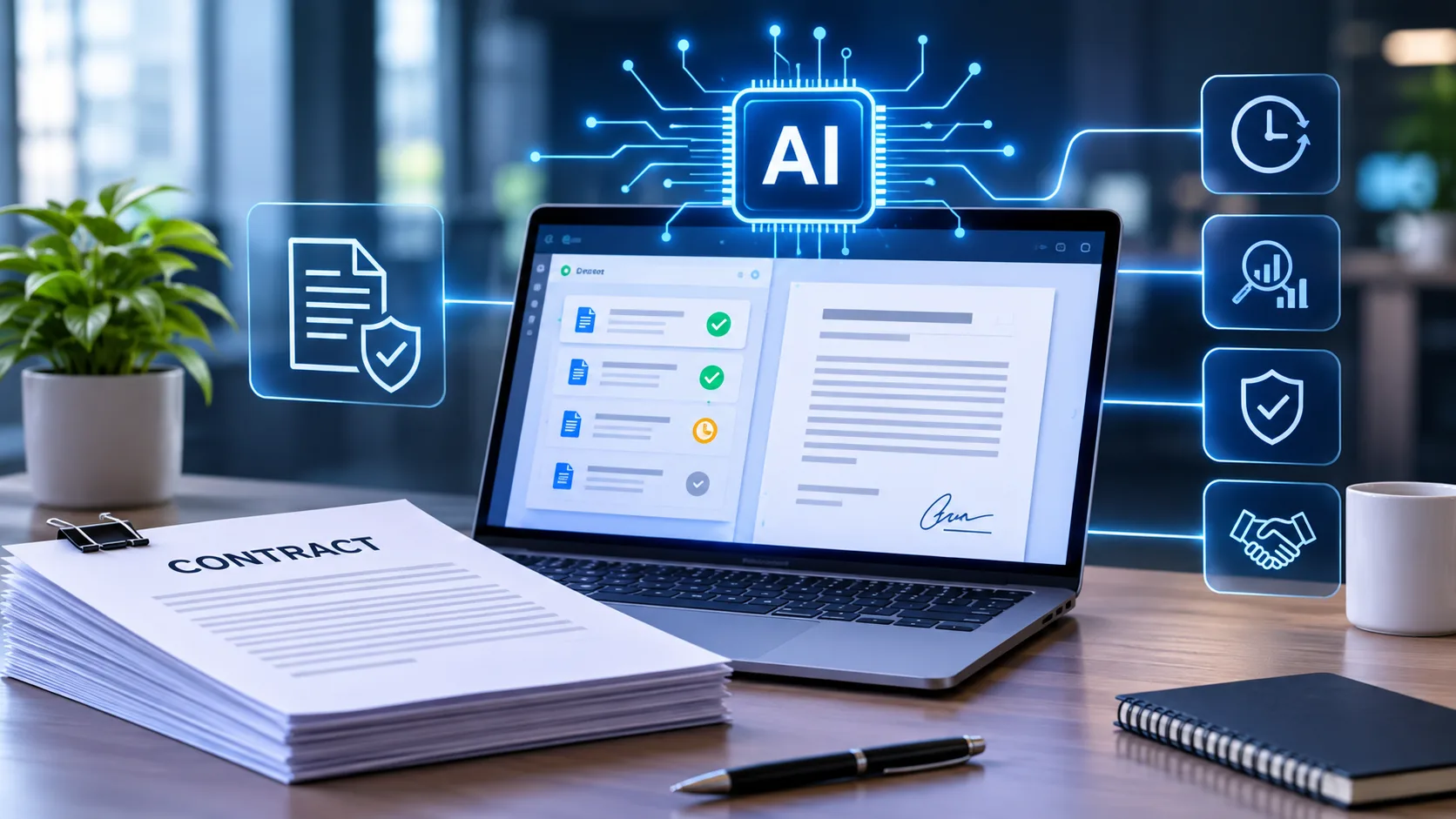
Every vendor in this market now sells an AI story. Read the product pages with care, though, and the stories split into two camps. One camp ships assistants: software that summarises clauses and answers questions, then waits for you to act. The other ships agents: software that drafts, redlines, chases evidence, monitors obligations and files the result without a human prompting each step. The gap between those camps decides whether AI contract management software saves your team minutes or hands hours back to the team.
This comparison takes the second camp at its word and tests the claims against each vendor’s own documentation. Nine platforms made the cut. For each one, you’ll see what the AI completes on its own, the data it can reach while it works, how its governance holds up and what the commercial terms look like in 2026.
What is AI contract management software?
AI contract management software applies artificial intelligence to the full life of an agreement: drafting it, negotiating it, extracting its terms, tracking its obligations and deciding what happens at renewal. The current generation goes further than the extraction tools of a few years ago. The stronger platforms now deploy named agents that carry a task from trigger to outcome, such as reviewing a counterparty draft against your playbook and returning a marked-up file.
The category sits beside older labels and has begun to swallow them. Contract lifecycle management (CLM) platforms have bolted agents onto their workflow engines. Review-first legal AI tools have grown repositories. Unified vendor platforms have pointed their agents at due diligence and spend as well as the contract itself.
Who buys it
Buyer identity shapes product design more than any feature list, and the nine platforms here split along clear lines.
- Legal teams buy review depth and redlining control. They want playbook-grounded redlines, precedent search, clause libraries and markups that hold up in negotiation. Tools such as Ironclad, LegalOn, DocJuris, Leah and Gatekeeper anchor here, focusing on automated first-pass reviews against approved templates to resolve bottlenecked legal workflows, with Gatekeeper adding the ability to evaluate supplier risk before redlining.
- Procurement and supplier-facing teams buy the post-signature half: obligation follow-through, supplier scorecards, renewal timing and negotiating strength. GEP anchors here, and Sirion courts both sides.
- Risk and finance teams buy control. They want vendor screening, audit evidence, spend oversight and regulatory cover in the same motion as the contract, while repository-first tools such as ContractSafe cover the record-keeping slice of it.
Knowing which chair you sit in shortens the shortlist faster than any demo.
Assistive AI or agentic AI
The distinction matters enough to define before ranking anyone. Assistive AI reacts: it summarises, flags, searches and answers when asked, and every output lands in a human queue. Agentic AI executes: handed a trigger and a boundary, it completes the task, logs each step, files the output and escalates only the exceptions. A platform can be excellent while staying assistive, as ContractSafe shows for teams whose main need is answers from a well-kept repository. The label on the tin should match the work you need done, because an “agent” that produces suggestions still leaves your team holding the follow-through.
What can the AI in contract management software do?
Across the nine platforms, the published capabilities cluster into five jobs.
- First-pass review and redlining. The AI reads a counterparty draft, checks each clause against your playbook, flags deviations and proposes replacement language. Platforms across the category deploy contract review agents to handle this initial pass against approved playbooks.
- Extraction and repository building. Agents ingest legacy agreements in bulk and pull parties, dates, values and obligations into structured fields that keep the record searchable. Sirion claims 90% faster contract centralisation from this alone.
- Natural-language answers with citations. Ask the portfolio a question, get an answer pinned to clause-level sources. Icertis pre-computes answers at ingestion for its Vera copilot; Ironclad’s Assistant handles the same job for business users.
- Obligation and deadline monitoring. The software extracts commitments and assigns owners, then chases the evidence. Sirion advertises 99% on-time obligation compliance; GEP’s Obligation Management Agent flags compliance risks in real time.
- Renewal and commercial follow-through. The widest gap in the category. Most platforms alert you to a renewal date. A smaller set connects the alert to spend data, performance records, market intelligence and the contract’s own terms, so the renewal becomes a decision rather than a deadline.
What that looks like by team
Legal. An in-house lawyer routes inbound paper to an agent for first-pass markup, then reviews the exceptions and returns the draft the same day. Volume stops dictating headcount, and standards stop varying by reviewer.
Procurement. A category manager lets agents handle supplier onboarding checks, then reads a scorecard that blends contract terms with delivery performance ahead of each renewal conversation. The negotiation starts from evidence instead of memory.
Risk and finance. A compliance lead points reviewer agents at certification evidence, insurance documents, questionnaires and regulatory frameworks, while finance validates invoices against contracted rates. Audit preparation becomes a report, not a quarter-long scramble.
What to look for in AI contract management software
Hold every vendor on your shortlist to the same five tests.
- Agents that finish, with proof. Ask the vendor to demonstrate one agent completing one job on your documents, start to end. Marketing language blurs the assistant-versus-agent line; a live run doesn’t.
- Data reach. An agent can only act on what it can see. If vendor due diligence, risk scores, performance data and spend live in other systems, the AI’s judgment stops at the contract’s edge. Unified platforms remove that ceiling; point solutions inherit it.
- Playbook grounding. Redlines should come from your standards, written in language your team controls, with reasoning attached. Generic markup creates review work instead of removing it.
- Governance and audit trails. Every AI action should log who triggered it, what it read, what it changed and who signed off. Regulated buyers should treat this as disqualifying, not desirable.
- Security posture in writing. Look for SOC 2 Type II paired with ISO 27001 certification, encryption, role-based access and a stated commitment that your contracts never train anyone’s models.
- Honest implementation timelines. The spread in this market runs from days to the better part of a year. A backlog that grows monthly can’t wait for a two-quarter rollout.
Best AI contract management software, ranked and compared
The table maps the field on the axis that matters: what the AI does and where it can act. Detailed entries follow.
| Platform | Named agents | Where the AI acts | Pricing signal
|
|---|---|---|---|
| Gatekeeper | 50+ included | Contracts, vendor risk, compliance evidence, spend | Quote-based, unlimited users |
| DocJuris | AI Contract Agent | Review, redlining, negotiation on your repository or its own | Public pricing page, no figures |
| Sirion | Extraction, Q&A, redline, obligation agents | Full contract portfolio | Demo only, premium tier |
| LegalOn | Agentic workflows | First-pass review inside Word | Pricing page, quote-based |
| GEP | Three lifecycle agents | Drafting through obligations, inside source-to-pay | Demo only |
| Leah | Generative AI platform | Authoring, review, analytics | Quote-based, per user |
| Ironclad | Assistant, Agents, Jurist | Lifecycle workflow and repository | Demo only |
| Icertis | Vera agents per stage | Portfolio-wide contract intelligence | Demo only |
| ContractSafe | None (assistive) | Repository answers, review, summaries | Tier prices on its G2 profile |
1. Gatekeeper: best for running contracts and vendors on one AI record
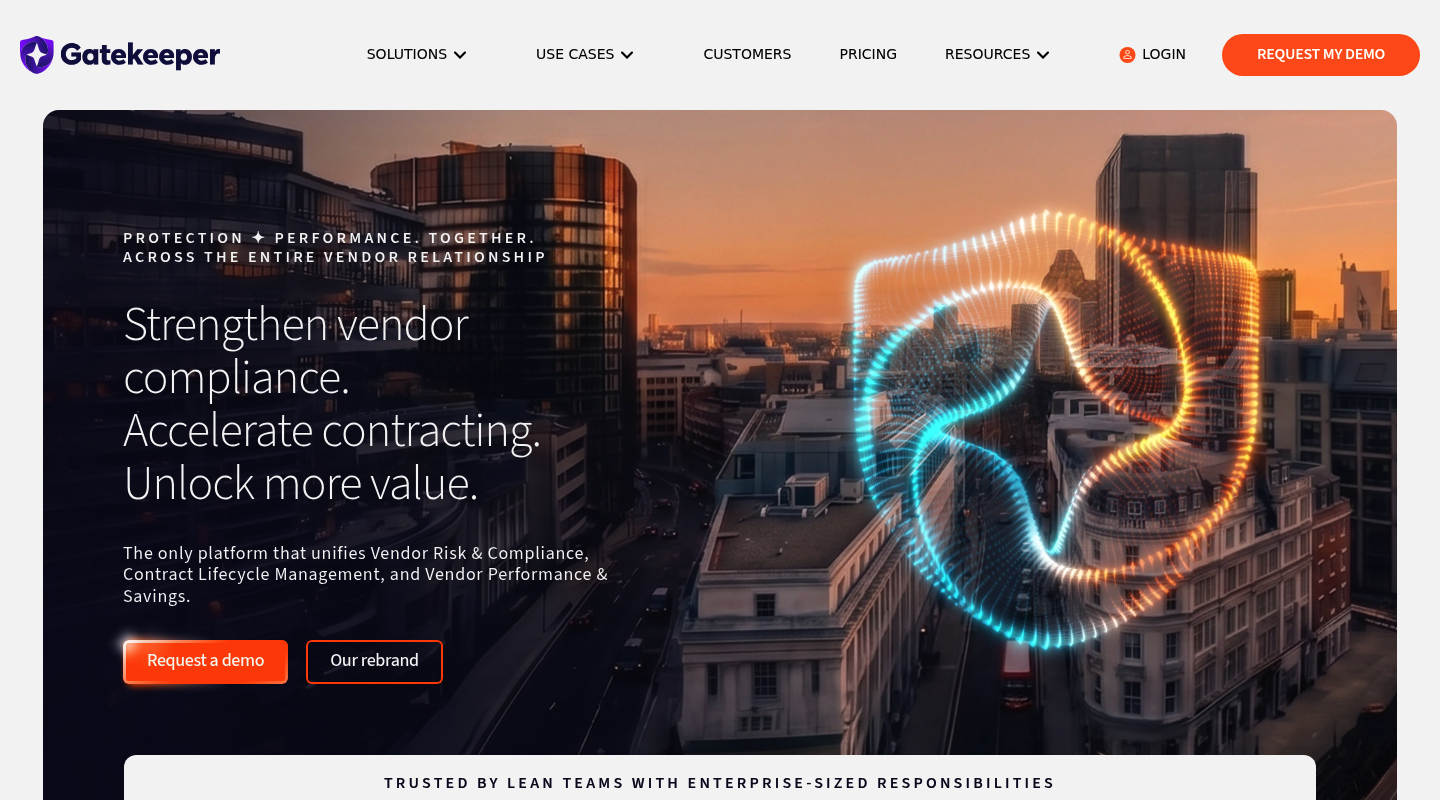
The verdict: Gatekeeper puts contract terms, vendor due diligence, risk monitoring and spend on a single record, so its agents act with context the contract-only platforms can’t reach. For teams that want AI to carry whole jobs rather than isolated tasks, it leads this field.
Gatekeeper includes all 50+ AI agents on every plan, organised around outcomes rather than demos: contract review against your playbook, due diligence on new vendors, framework evidence checks, invoice validation against contracted terms and renewal preparation. Legal also gets a review agent that checks drafts against approved playbooks. The agent reviews the supplier’s risk profile before redlining, keeping every suggestion within legal-controlled clause libraries. By automating first-pass reviews with guard-railed templates, it directly relieves the General Counsel’s primary friction point. Historically, every non-standard agreement landed on their desk, creating severe redline bottlenecks. The company reports 95% faster reviews and approvals through its agents, eliminating delays without sacrificing oversight.
Features:
- All 50+ AI agents included on every plan, with no separate AI charge
- Contract review agents that automate first-pass reviews and redlining against guard-railed templates and approved clause libraries
- Reviewer agents that assess SOC 2, ISO 27001, DORA and ESG evidence from vendors
- 24/7 monitoring of vendor financial stability and cyber posture through MarketIQ
- Renewal automation with obligation tracking on every agreement
- Invoice validation against contracted terms in the spend module
- No-code Kanban workflow engine, with 800+ live customer workflows
- 1,700+ integrations through Gatekeeper Interconnect, plus unlimited users and e-sign
- Certifications spanning ISO 27001:2022, ISO 9001:2015, SOC 1 Type II plus SOC 2 Type II
Pros:
- Resolves GC bottleneck and boosts review speed by eliminating manual first-pass checks while maintaining complete control over approved language
- Deploys in under four months, compared to the multi-quarter rollouts common at the enterprise end
- Customers include Auto Trader, Pets at Home, FNZ, DAC Beachcroft and SumUp, with renewals under management past $50 billion
- All 50+ AI agents are included on every plan standard rather than as a priced add-on
Cons:
- Lack of transparent pricing card requires going through sales discovery, and licensing tiers scale with total third-party volume
- G2 user reviews note that setting up advanced automation and custom integrations can require dedicated configuration time during initial onboarding
Pricing: Gatekeeper scopes quotes to vendor volume and module mix. Unlimited users and unlimited e-sign come standard, which simplifies the maths once the conversation starts.
2. DocJuris: best for legal teams negotiating on third-party paper

The verdict: DocJuris builds AI that completes the markup rather than suggesting it, and it refuses to make you migrate: bring your own repository or run its own. For legal teams buried in counterparty drafts, that focus pays off fast.
The platform structures contract work as a six-stage pipeline covering screening, redlining, negotiation, repository assessment, extraction and compliance analytics, with AI driving each stage. One click applies your playbook to a Word or PDF draft and returns counterparty-ready markup with issue lists and exception tables attached.
Features:
- One-click, playbook-driven redlining of Word and PDF drafts
- An AI Contract Agent plus Custom Actions that run inside Microsoft Word
- Playbook OS for building and maintaining AI-powered negotiation standards
- Extraction that reads any format, pulling terms, dates, obligations and renewal data through to an existing CLM
- Searchable repository that tracks obligations and renewals alongside risk
Pros:
- The AI produces finished negotiation output rather than a pile of flags for a human queue
- Works on top of whatever repository you already own
- A published pricing page sets out the commercial model, a rarity here
Cons:
- Scope ends at the contract: fraud monitoring, supplier scorecards, audit management and spend analytics sit outside the product
Pricing: Quote-based despite the public page; expect an annual platform subscription with unlimited users, or a one-time build fee with hosting and usage credits, scoped on a sales call.
3. Sirion: best for enterprises deploying agents across huge portfolios
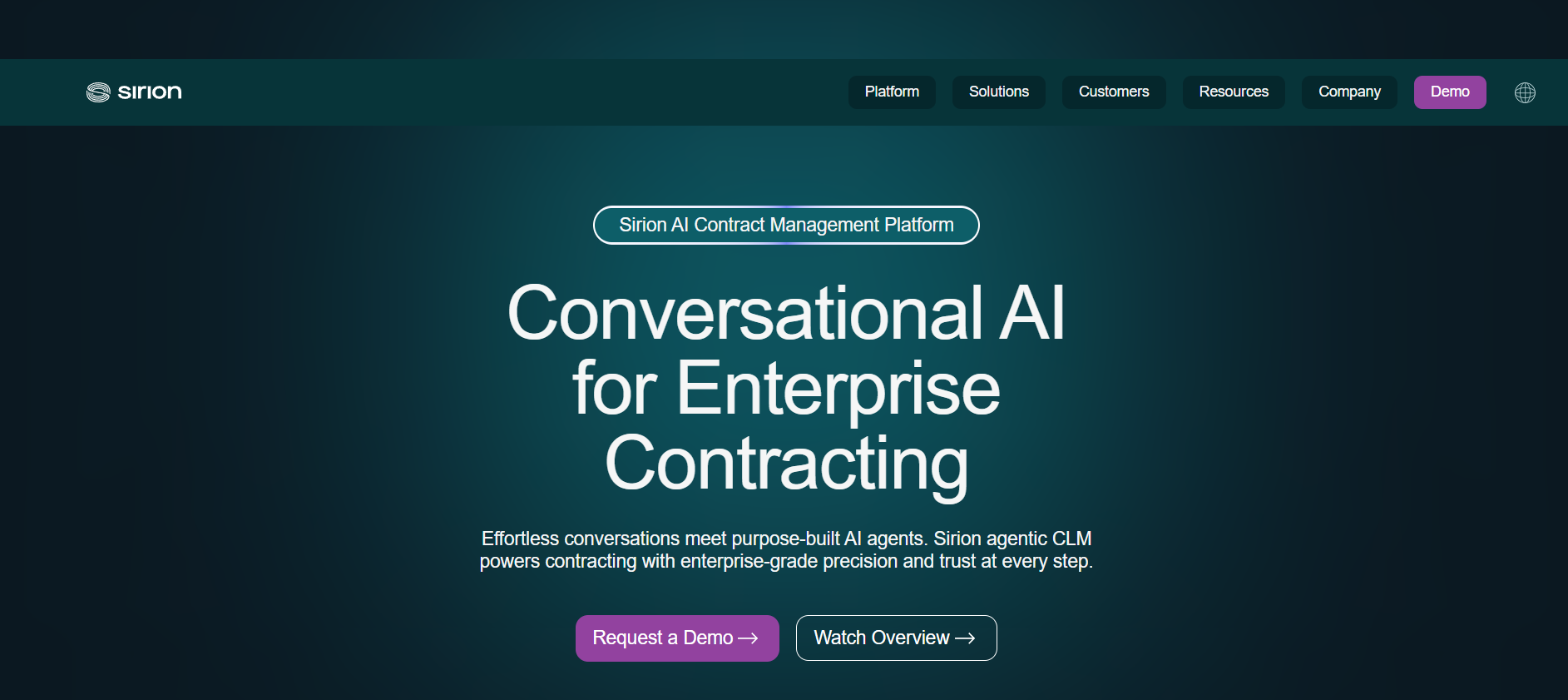
The verdict: Sirion sells agentic CLM with conviction: agents centralise the repository, answer questions with citations, draft from your playbook, redline third-party paper and monitor obligations. For large contract estates, few rivals match that breadth.
The company claims 90% faster contract centralisation when its extraction agents ingest an estate, and 99% on-time obligation compliance once its monitoring agents take over. AgentOS, its build-your-own layer, lets enterprises connect custom agents to their own data.
Features:
- Agents that extract and normalise legacy contracts into a governed repository
- AskSirion natural-language Q&A with clause-level citations
- Autonomous first drafts from your playbook, with risk pinpointing and proposed redlines on third-party paper
- Obligation and service-level agreement (SLA) monitoring that surfaces gaps and triggers owners
- AgentOS for building, testing, deploying and connecting custom agents to enterprise data
Pros:
- Strong dual DNA across legal and procurement, with solution paths for finance and IT as well
- Obligation and SLA follow-through is a flagship strength, not an afterthought
Cons:
- Premium pricing and one of the longer time-to-value curves in the category, which smaller teams feel hardest
Pricing: No published pricing; the company positions at the premium end of the market and scopes by portfolio.
4. LegalOn: best for attorney-grade first-pass review
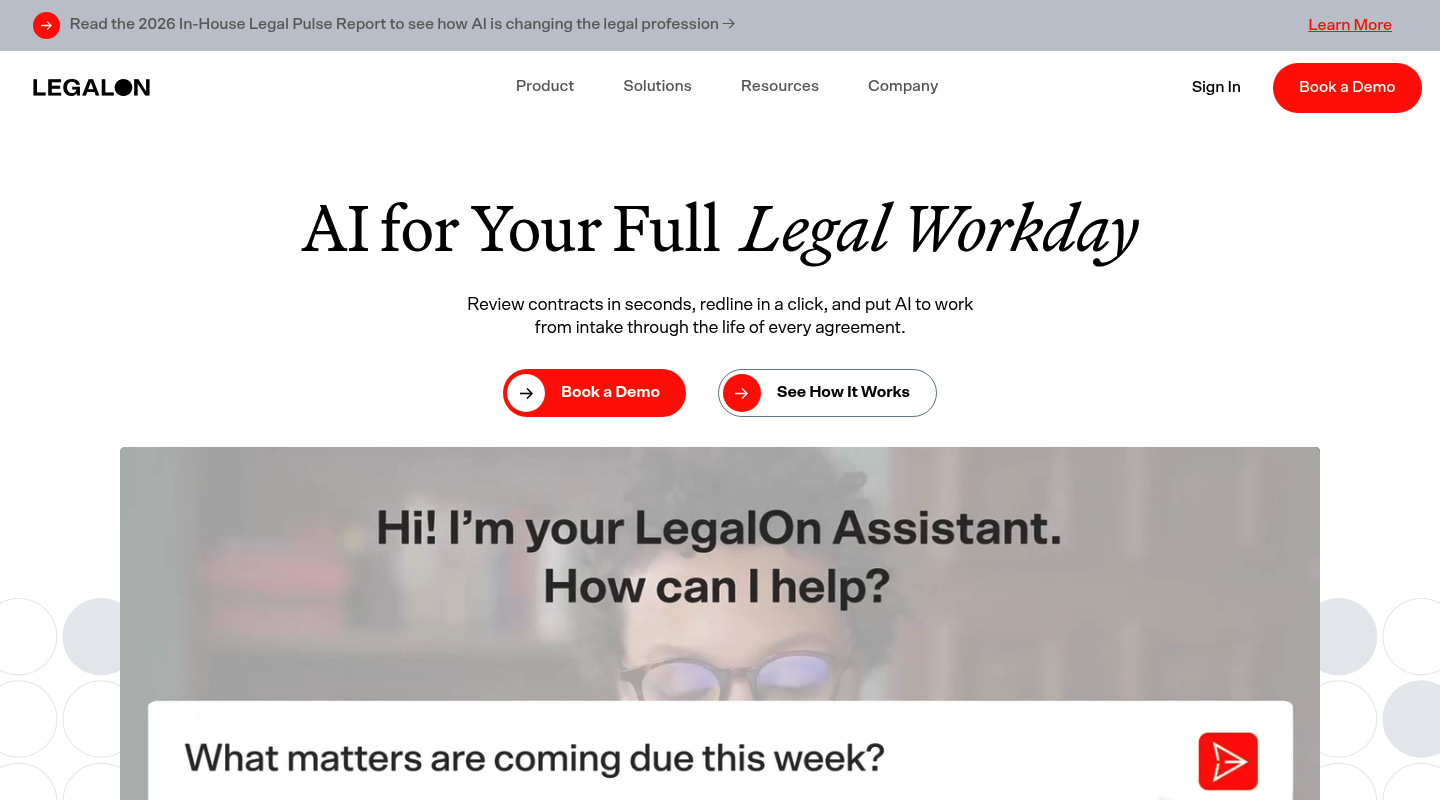
The verdict: LegalOn grounds its AI in attorney-built playbooks and gets legal teams productive almost at once, with review claims of up to 85% faster per contract. As a review engine it excels; as a management layer it stays deliberate in scope.
More than 9,000 legal teams use the platform, which reviews each contract against attorney-built or custom playbooks, flags risk with citations and suggests redlines inside Word. Vault, its repository product, turns stored agreements into searchable intelligence, and an agentic workflows layer extends the review core.
Features:
- Review against attorney-built playbooks, with custom playbooks built from your own guidelines
- Redline suggestions applied in a click inside Microsoft Word
- Vault repository that turns stored agreements into searchable, tracked records
- Agentic workflows plus matter management for intake and triage
- Multi-language review and translation
Pros:
- Per-seat model with no implementation fees and no per-contract charges, per its published pricing page
- Three clear tiers (Core Review, Contracting Suite, Productivity Suite) make scoping conversations short
Cons:
- Obligation visibility runs through the repository rather than an active monitoring workflow, so post-signature follow-through stays with your team
Pricing: A public pricing page with no figures; quotes build around team size and capability tier.
5. GEP: best for procurement teams inside a source-to-pay suite
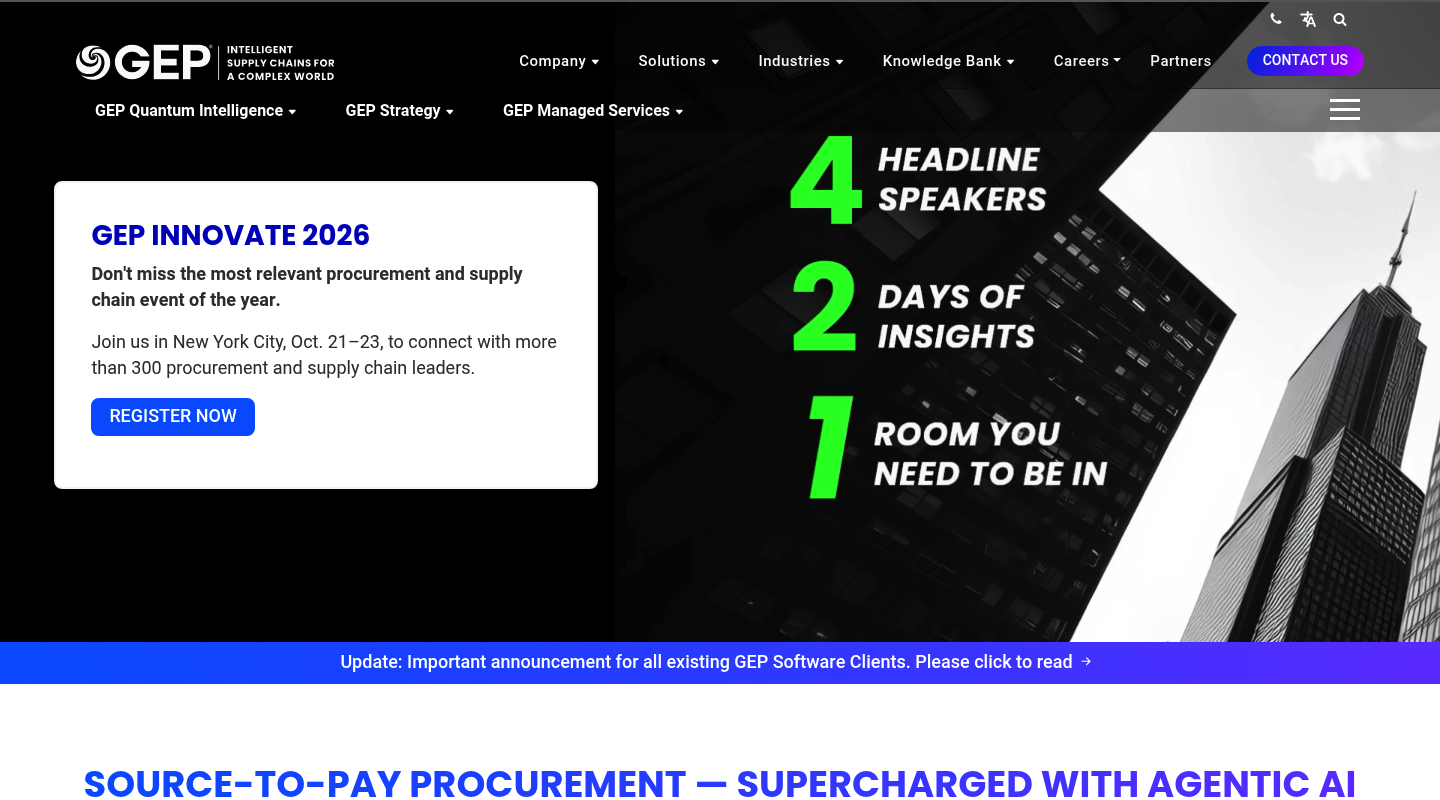
The verdict: GEP’s Quantum Intelligence CLM is AI-native contract management for procurement, with three named agents covering authoring, redlining, extraction and obligations. If your organisation runs GEP for sourcing and purchasing, the contract AI slots in; if not, the suite question comes first.
The Authoring & Redlining Agent produces first drafts from playbooks via prompts, then flags clause deviations and suggests redlines. The Extraction & Digitization Agent structures metadata, including bulk legacy upload. The Obligation Management Agent extracts commitments and assigns owners, flagging compliance risks in real time, while agreed prices and SLAs flow into sourcing and purchasing workflows.
Features:
- Authoring & Redlining Agent for prompt-driven first drafts and deviation flags
- Extraction & Digitization Agent with bulk legacy upload and unified clause search
- Obligation Management Agent with owner assignment and real-time risk flags
- Mass amendments when policies or regulations change
- Contract terms pushed into sourcing and purchasing workflows
Pros:
- Agent coverage spans the lifecycle rather than stopping at review
- Policy-driven mass amendment is a genuine differentiator for regulated portfolios
Cons:
- Built for CPOs and category managers throughout, so legal teams adopting it on its own will find the fit narrow
- Value assumes the wider source-to-pay suite; the CLM is one module, not a standalone purchase decision
Pricing: No pricing visibility at all; engagement runs through demos and RFP contact.
6. Leah: best for generative AI drafting in legal departments
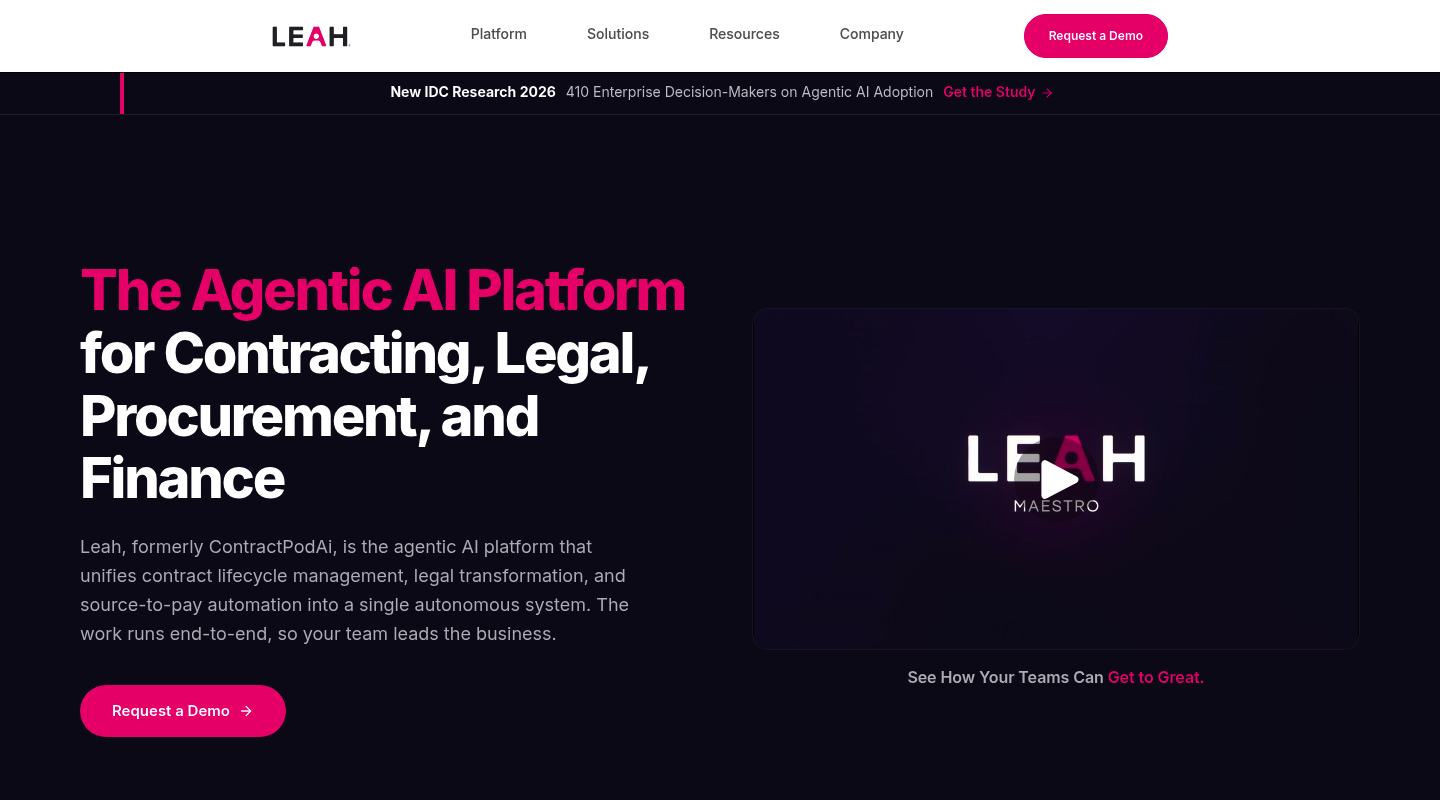
The verdict: Leah, the platform that rebranded from ContractPodAi in January 2026, stakes its identity on generative AI for legal and contract work. The AI earns strong marks, while the commercial model and scope ask for commitment.
The platform automates contract authoring, review, management and analytics with an AI-first posture, and adds a vendor negotiation portal plus multiple language options on top of its repository.
Features:
- Generative and agentic AI applied across legal and contract tasks
- Contract repository and creation tools that handle third-party paper
- Vendor negotiation portal
- Advanced analytics with real-time metric tracking
- Multiple language options
Pros:
- Generative AI capability rates among the stronger showings in the category, at 4.7 on Gartner Peer Insights across 170 ratings
- Good visuals and well-regarded customer service
Cons:
- It integrates with Adobe Sign but not DocuSign, and onboarding runs long with a steep learning curve
Pricing: Enterprise quote-based and priced per user, with reports putting typical spend in the $55,000 to $75,000 a year range.
7. Ironclad: best for high-volume contract workflow automation
The verdict: Ironclad layers a three-tier AI suite onto a proven CLM, running from an Assistant for repository questions up to Jurist, its AI contract partner for commercial lawyers, with workflow Agents in between. For legal operations teams moving serious volume, the machinery is hard to fault.
Jurist drafts and redlines against playbooks, grounds negotiation suggestions in your historical positions, extracts critical terms and calls on agents for complex tasks. Ironclad trains the wider AI on patterns from more than 2 billion contracts, and it surfaces stalled deals and missed renewals, along with obligations at risk. Zero-data-retention options and customer-held keys come with human-in-the-loop governance that the company puts front and centre.
Features:
- Ironclad Assistant for natural-language questions over the repository
- Ironclad Agents automating approvals and reminders, with routing run to your rules
- Jurist, which drafts, redlines, negotiates and extracts, grounded in historical positions
- Alerts that surface stalled deals, missed renewals, open obligations and other exceptions
- Zero-data-retention options with customer-managed encryption keys
Pros:
- Workflow depth that scales across business units and contract types
- Governance posture that compliance reviewers will approve of
Cons:
- Reports put costs around $80,000 a year for 100 licences, with workflow builds adding about $5,000 each
Pricing: No published pricing; licence-based quotes with per-workflow charges, scoped through a demo.
8. Icertis: best for global enterprises with complex portfolios
The verdict: Icertis wraps its contract intelligence platform in Vera, a copilot plus named agents for each lifecycle stage, and every AI action lands in an audit log. The capability runs deep, and so do the cost and the timeline.
Vera Copilot answers plain-language questions with clause-level citations pre-computed at ingestion, finds any contract, clause, counterparty or obligation, triggers workflows and approves redlines from one interface. Stage agents cover composition, playbook creation, risk review, redlining, obligations, fulfilment and insight analytics, acting within boundaries the customer sets. The company also acquired legal-tech startup Dioptra in November 2025 to extend its automation tooling.
Features:
- Vera Copilot with clause-level citations across the whole portfolio
- Named agents per lifecycle stage, covering composition, risk review, obligations and analytics
- Every AI action logged and auditable
- Grounding in the customer’s own contract ontology and playbooks
- Deep ERP and CRM connections, including SAP Ariba and Salesforce
Pros:
- Portfolio-scale intelligence that Fortune 100 buyers trust
- Auditability built into the AI layer rather than promised around it
Cons:
- Reports put implementation in the $70,000 to $120,000-plus range with six-figure first-year costs, and rollouts run months
Pricing: Enterprise quote-based through demo requests only.
9. ContractSafe: best for assistive AI on a disciplined repository
 The verdict: ContractSafe applies its AI to the job most teams start with: a secure, searchable contract record whose alerts fire before key dates pass. The AI answers and reviews rather than acts, and the product is honest about that boundary.
Built for teams that have outgrown shared drives and spreadsheets, the platform centralises agreements with lifecycle visibility, obligation tracking and automated alerts, while its AI handles contract organisation and clause discovery. Ask the repository where a liability cap sits and the AI chat locates the governing clause and returns the answer.
Features:
- Secure central repository with lifecycle visibility and obligation tracking
- AI chat that answers contract questions by finding the clause behind each answer
- AI-assisted contract review and analysis, with playbooks reviewers describe as flexible
- Automated key-date reminders plus scheduled reporting emails for business partners
- Two-way e-signature, Word integration and version control
Pros:
- New team members search and file contracts with zero prior training, per the reviewers who administer it
- Its G2 profile lists tier starting prices, a rare visibility in a field that quotes to scope
Cons:
- Assistive by design: the AI summarises, parses and answers, and leaves the acting to your team
Pricing: ContractSafe’s G2 profile lists three tiers that open at $450, $660 and $815 a month; the company’s own pricing page describes plans without printing figures and bills in US dollars.
Benefits of agentic contract management
The vendor-published numbers across this field tell a consistent story, even allowing for marketing gloss.
Hours return to the team every week
Vendor reports across the market cite substantial time savings, such as up to 85% faster contract review times or significant reductions in weekly administrative tasks. Multiply these efficiencies across a year and the business case becomes clear before addressing broader strategic benefits.
Renewals stop running on autopilot
Platforms that watch deadlines prevent the quiet losses. An agreement that renews unexamined carries last year’s terms into next year, price drift included, and alert-only tools catch the date without preparing the decision. Agent-driven platforms assemble the context the decision needs before the window closes.
Standards hold without supervision
An agent applies the same playbook to the hundredth contract as the first. Reviewer-to-reviewer variance, the quiet risk in any manual process, disappears, and the audit trail proves it held.
Challenges to plan for
- Agent claims outrun shipped product. The word costs nothing to print. Make every shortlisted vendor run one agent through one complete job on your own documents before you score them.
- Data boundaries set the ceiling. An agent inside a contract-only platform gives contract-only answers. Decide up front whether you need the AI to weigh vendor risk and spend, because no amount of model quality compensates for data it can’t see.
- Governance needs the same scrutiny as capability. Insist on action logs, permission inheritance, change history and human checkpoints for consequential steps. Platforms vary more on governance detail than on headline features.
- Budgeting takes real discovery. None of the nine prints a full rate card on its own site; ContractSafe comes closest, with tier starting prices visible on its G2 profile. Reported figures elsewhere range from around $55,000 a year to six-figure first-year commitments at the enterprise end, so run parallel conversations and force comparable quotes.
The deciding factor: what your agents can see
Strip away the branding and one architectural question predicts how useful any of these platforms will feel in a year: does the AI read the contract alone, or the contract in context?
Picture a supplier agreement auto-renewing in 45 days. A contract-only agent, however sharp, reports the notice period, the uplift clause, the termination mechanics and little else, because that’s the whole record it holds. An agent on a unified record reads the same clauses next to the supplier’s delivery scores, its latest SOC 2 evidence, a financial-stability alert from the past quarter and the gap between invoiced and contracted spend. The first output is a summary. The second is a recommendation with grounds to act.
How to choose AI contract management software
Step 1: make the vendor show an agent finishing a job
Not a slide, not a canned environment. Insist on your own documents and a single task carried from trigger to outcome. The platforms with real agentic depth will welcome the test.
Step 2: map the AI’s data reach before comparing features
Write down where your vendor records, risk assessments, performance history and spend data live today. If the answer is “three other systems,” a contract-only platform locks that fragmentation in, and its AI inherits the blind spots.
Step 3: audit the audit trail
Trigger an AI action in the demo, then ask to see the log. Who initiated it, what it read, what changed, who approved. If the trail takes effort to produce in a sales demo, picture producing it for a regulator.
Step 4: price the whole stack
Licence fees are the visible layer. Add workflow build charges, suite prerequisites, per-user scaling and implementation services, then compare totals rather than entry points. The spread between platforms widens fast once everything is on the table.
Step 5: match the rollout to your backlog
Deployment claims here range from under four months to the better part of a year. A team drowning in unreviewed paper needs value this quarter, and should give time-to-value the same weight as raw capability.
FAQs about AI contract management software
What does AI contract management software do day to day?
It reviews inbound drafts against your playbook, proposes redlines, extracts terms and obligations into a searchable record, answers questions about your portfolio with citations, and watches renewal dates and commitments so deadlines surface before they bite. Agentic platforms carry those tasks to completion; assistive ones prepare the work for a human to finish.
How do AI agents differ from AI assistants in contract software?
An assistant responds when asked and leaves outputs in your queue; an agent takes a trigger, completes a defined task within set boundaries and logs the result. Platforms like Sirion, Icertis, Ironclad, GEP, and Gatekeeper name and configure their agents by task across vendor due diligence, contract review, compliance evidence, and spend validation.
How much does AI contract management software cost in 2026?
No vendor on this page publishes a full rate card on its own site, though ContractSafe’s G2 profile shows tiers from $450 a month. Reports put Leah around $55,000 to $75,000 a year, Ironclad near $80,000 a year for 100 licences plus workflow charges, and Icertis implementations between $70,000 and $120,000 or more. Other enterprise platforms quote to scope, with pricing typically determined by third-party volume and module selection. Budget through parallel discovery calls rather than published figures.
Is AI contract management software safe for confidential agreements?
The credible platforms publish their security posture: look for SOC 2 Type II alongside ISO 27001 certification, encryption in transit and at rest, role-based access and explicit no-training commitments on customer data. Ironclad goes further with zero-data-retention options and customer-held keys. Treat any vendor that can’t produce certificates on request as disqualified.
Can AI contract management software replace legal review?
No, and the better vendors don’t claim it. The AI owns the first pass: reading, flagging, extracting and proposing. Lawyers own judgment calls, negotiation strategy, relationship context and the final word on risk. What changes is the ratio: hours of mechanical reading become minutes of exception handling, which is where the published savings figures across this field come from.
The bottom line on AI contract management software
The agent era has arrived in contract software, and the brochures have converged even while the products haven’t. Review-first tools like LegalOn and DocJuris sharpen the legal workflow. The enterprise platforms, Sirion and Icertis among them, bring agents to vast portfolios at enterprise prices and timelines, while Ironclad matches them on workflow depth. GEP serves its procurement buyers well inside its own suite, and ContractSafe keeps the assistive end of the market honest.
Gatekeeper finishes first on the test this page set, which was agents judged by the work they complete. Its unified architecture connects due diligence checks, compliance evidence reviews and invoice validation past the edge of pure contract platforms, with all 50+ AI agents included on every plan. Shortlist two or three of these platforms, put the same live task in front of each, and let the finished work decide.